Brazil’s New Biofouling Rules: What Ship Operators Need to Know
Last updated June 1st, 2026.
The rules for calling Brazil changed in 2025. Read the operator guide: what’s actually required, what’s still moving, and a port call checklist.
The Short Version
Brazil now requires vessels to arrive clean – not just managed. Under NORMAM-401, Chapter 4, any commercial vessel over 24 metres calling, anchoring, or conducting STS in Brazilian waters must demonstrate a hull with no macro-fouling, backed by high-resolution inspection evidence.
The rules are in force today. What keeps moving is the penalty start date. It was February 2026, then June 2026, and as of 1st of June 2026 it is being pushed again, likely to 2027 or later. Treat any single enforcement date as provisional until the Navy confirms it in writing. The more useful point: the requirement to arrive clean already applies, and the reasons to comply have nothing to do with the penalty calendar.
Who It Applies To
Any vessel ≥24 metres LOA that will anchor, berth, drift, or conduct STS in Brazilian Jurisdictional Waters (AJB).
If you run bulk, tank, or general cargo vessels with any Brazil rotation, this applies to your fleet.
The Key Dates (And Why There’s Confusion)
| Date | What Happened |
|---|---|
| 10 Jun 2025 | NORMAM-401 Chapter 4 entered into force |
| 1 Feb 2026 | Original penalty start date (widely circulated) |
| 18 Dec 2025 | Portaria 193/2025 issued — pushed penalties to June 10 2026 |
| 29 May 2026 | Brazilian Navy confirms at a seminar that penalties are postponed to 2027 or later |
Many operators still have February 2026 in their heads from early circulars. Those that were up to date may have mentally replaced that date with June 2026. Now, as of June 1st 2026, that date is no longer valid. The Brazilian Navy has confirmed the date is postponed to at least 2027.
The date being postponed twice shows the strong debate that is going on between Brazilian authorities and the industry. For now, the date where penalties will apply remains unknown, but be aware that the “orientation phase” before the penalties is not risk-free.
In Force vs. Enforced
There is a wide gap right now between what the regulation says and how it actually runs at the quayside.
On paper: you arrive at fouling level 1 or below. If you carry level 2 macrofouling, you clean, and that cleaning is meant to use vacuum-capture equipment that contains both macro- and microfouling down to a certain level of particles-per-million (PPM).
In practice, today:
- There is no approved vendor list. The Navy has not certified hull-cleaning companies. In principle any provider can claim to operate an approved biofouling reclamation system, with no oversight.
- There is no certified equipment yet. Fully compliant vacuum systems cost several million dollars and very few exist in the country. Most providers capture macro- but not microfouling. Certification of equipment is expected in future, not now.
- No single authority is checking documents on arrival. There is currently no clear person in charge. It is not obvious whether port state control, the environment department, or another organization altogether will manage this. In practice the agent requests documents from the master to be on the good side.
- An inspection report is valid for 12 months. As the rule stands, a vessel can arrive on a clean report that is several months old, even after picking up fouling on the way, and the report still counts. The same report also covers movement between Brazil’s biogeographic regions, so you do not need a fresh inspection at each inter-region move if you hold a report that is less than 12 months old.
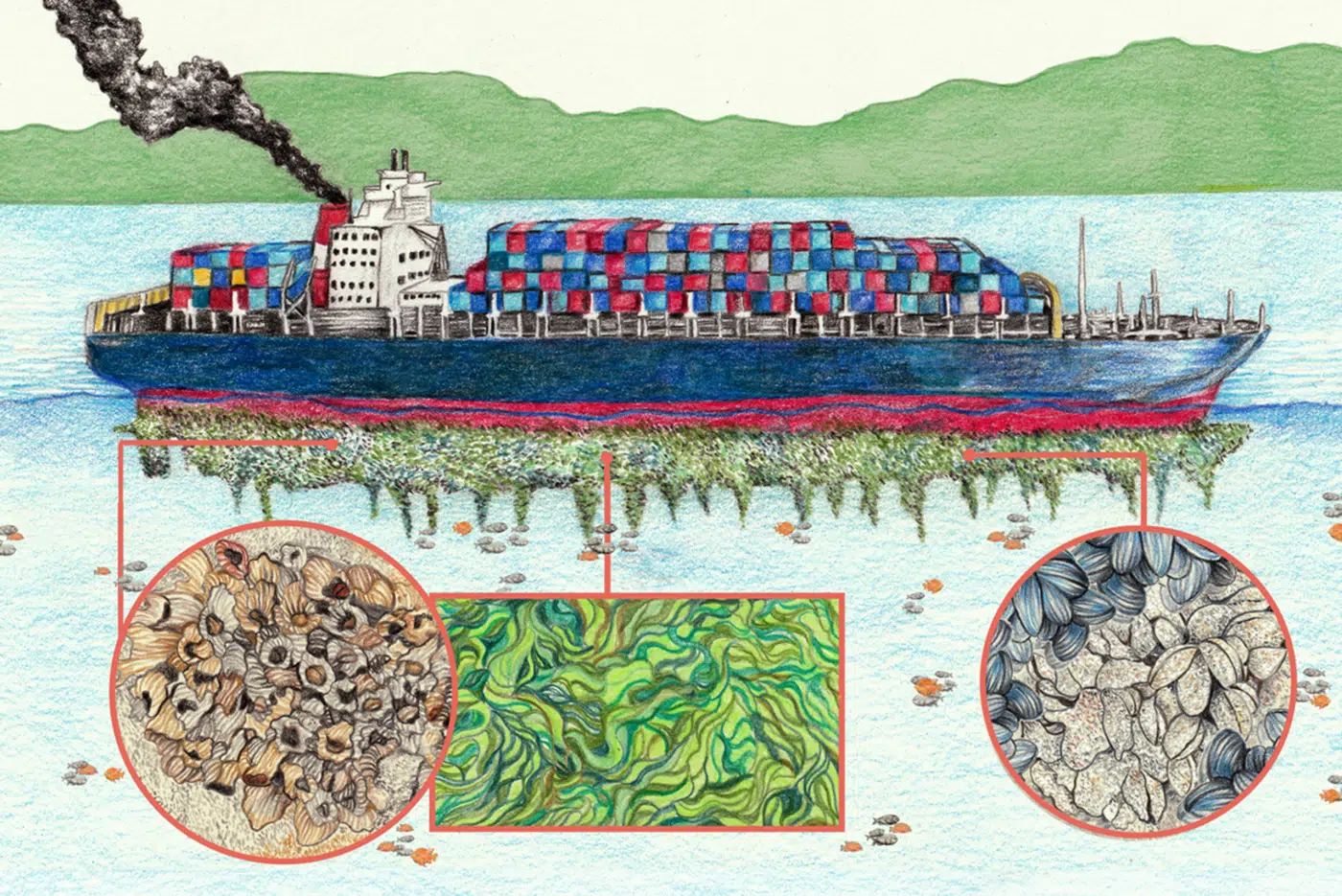
Biofouling can have a significant impact on a vessel’s fuel performance. Illustration: Ricardo Macía / China Dialogue Ocean
What You Actually Need
Four things, in plain terms, to be prepared for Brazil’s biofouling regulations:
- Biofouling Management Plan (BFMP): vessel-specific, must be onboard
- Biofouling Record Book: current and actively maintained
- Inspection evidence: high-resolution photos/video of hull and niche areas (sea chests, thrusters, rope guards), confirming fouling level ≤1. Brazil uses a 0–5 scale: Level 0 is a clean, bare hull; Level 1 is a slime film (microfouling); Level 2 and above means visible macrofouling (barnacles or worse). Level 1 is the maximum permitted for entry.
- If you need to clean on arrival: the initial intent of the regulation was to limit this to only approved vendors with biofouling reclamation systems. Since no enforcement is in place at this time, cleaning is still possible on arrival in Brazil as normal – but we recommend going for vendors who have some form of biofouling reclamation system to be on the safe side.
Inspection evidence is where most operators will be exposed. According to the strictest interpretation of the rules, an inspection report loses its validity if the vessel has had significant idle time or prolonged slow-steaming after it was conducted – fouling accumulates fast in warm, productive waters. As a working rule: if more than four to six weeks have passed since the last inspection, or if the vessel has been at anchor for extended periods, factor a re-inspection into the pre-Brazil port call. The cost of an additional dive inspection is trivial compared to the cost of arriving with documentation that won’t hold up.
The Biogeographic Regions Catch
Brazil divides its coast into biogeographic marine regions. The compliance requirements don’t just apply on entry into Brazilian waters; they apply again when you move between regions with intent to call or anchor.
A vessel rotating North/Northeast → Southeast/South faces multiple compliance checkpoints, not one. A fouling event between ports (especially after a prolonged anchor stay) can trigger authorisation requirements mid-rotation.
Map your region transitions at the voyage planning stage, not on arrival.
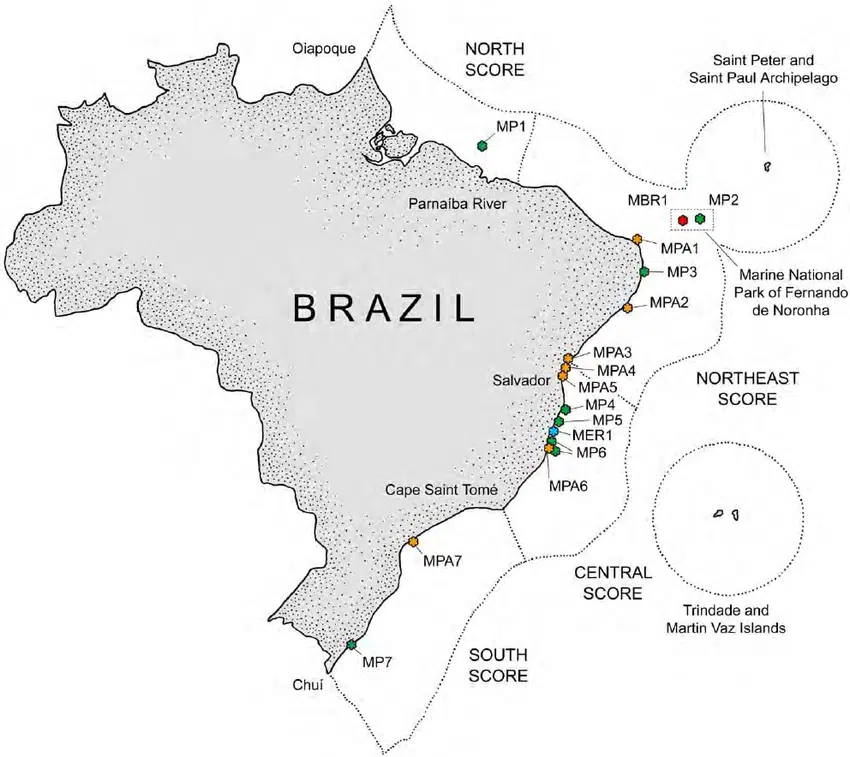
Map of the Marine Protected Areas (MPAs) of Brazil. doi:10.1371/journal.pone.0014631.g006 by Diego Rodriguez
If You Arrive Fouled
Reactive in-water cleaning in Brazil is a regulated activity. You cannot simply arrange a dive team alongside.
To clean in Brazilian waters you need prior authorisation, an approved provider with biofouling capture technology, and a documented waste disposal chain. Getting all of that aligned during a port call window while cargo operations are waiting is where a hull condition problem becomes an off-hire problem.
As it stands today, enforcement is lacking and cleaning on arrival may be operationally possible – but the rules stand already, and the last thing an operator would want is to realize on the way to Brazil that cleaning will not be possible on arrival.
Clean or inspect before you call Brazil where you can. Fixing it on arrival is possible, but it is the more expensive and less predictable path.
Checklist: Brazil Port Call Readiness
This is how you prepare for compliance with Brazil’s new biofouling regulations.
Before the voyage
☐ BFMP and Biofouling Record Book onboard and current
☐ Biogeographic region transitions mapped across the full rotation
☐ Approved hull cleaning providers identified at relevant Brazilian ports (using local agents or an online platform like CleanQuote)
Pre-arrival
☐ Hull + niche area inspection completed at last port before Brazil
☐ Evidence confirms fouling ≤1, with recent timestamps
☐ No idle or slow steaming periods after latest inspection
If fouling risk exists
☐ Decision made: clean offshore before entry vs. authorised reactive hull cleaning in Brazilian waters
☐ Submission dossier ready: BFMP extracts, inspection media, AFS documentation, method statement
In Brazil
☐ Each inter-region move treated as a compliance checkpoint
☐ Re-inspection planned after prolonged anchor/berth stays
☐ All cleaning fully documented in the Record Book
The Bottom Line About Brazil Biofouling Regulations
Brazil’s biofouling regulations are manageable if you treat hull condition as a voyage planning discipline rather than a maintenance afterthought. Keep fouling low, keep documentation current, and don’t rely on fixing problems reactively inside a Brazilian port window.
Don’t wait for the enforcement date to settle before you act. The regulation has always been the smaller half of the case for a clean hull. We recently watched an operator turn down a 20k cleaning in Brazil and then burn through roughly 200k in extra fuel sailing fouled. That maths holds whether penalties start next year or the year after.
The operators who handle this well won’t be the ones who guessed the enforcement date right. They’ll be the ones who kept their fleet in a position where the date didn’t matter much either way.
How CleanQuote Helps
CleanQuote is built for exactly this kind of regulatory environment.
Your fleet’s underwater inspection history, cleaning records, idle periods, and fouling exposure data all live in one place; ready to pull as an evidence pack when you need it. Our global supplier network includes providers operating in Brazilian waters, so you’re not scrambling for a compliant hull cleaning vendor at the last minute.
If you’re building a Brazil compliance workflow into your voyage planning, get in touch and we can show you how other operators have set it up.
- Share:


